JULY—A MONTH FOR MEMORIES
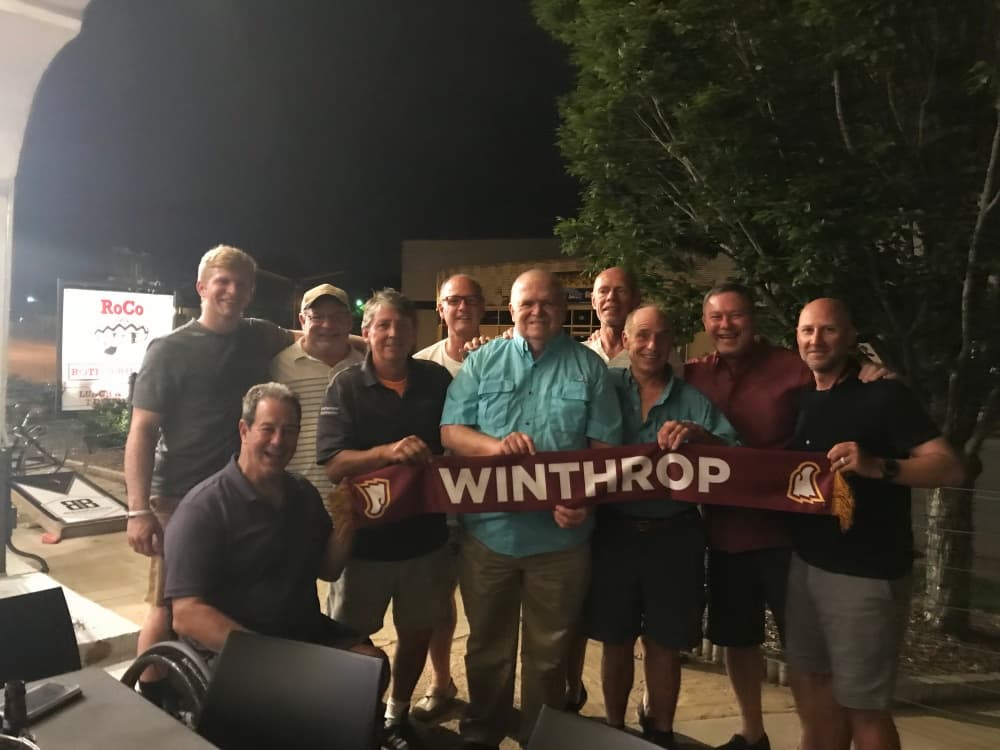
A few of my old players at a soccer reunion in 2018.
For no particular reason, other than the fact that withering heat has kept me indoors far more than I’d like, along with an unwillingness or inability (take your choice and both are likely right) to write only so many hours a day, of late I’ve been doing more than an ordinary amount of reminiscing. A good bit of it has focused on a period in my life that I’ve mentioned over the years, but not shared in any great detail, in this newsletter. The World Cup soccer matches of recent weeks have released a flood of mostly warm, winsome memories. Those fond recollections involve a 12-year period when I doubled my workload at Winthrop University by taking the position of the institution’s first soccer coach in addition to being a full-time history professor.
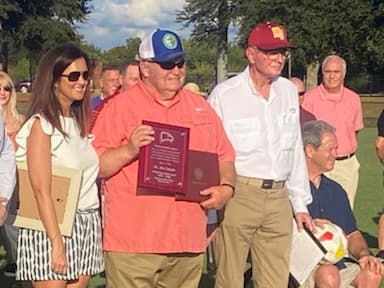
Recogntion at halftime of a match of an endowed soccer scholarship in my name funded by former players. That’s my daughter, Natasha, on my right and one of my earliest players and a fellow who was almost like an adopted son, Frank Griffin, on my left. He went on to enjoy a highly successful 30+ year college coaching career in women’s softball.
Looking back on that period (1975-1986) I don’t know how I did it. Today merely thinking about the rat race I was running wears me out. That’s especially true given the fact that I was also trying to be a productive scholar (I guess a handful of academic books and more than 100 articles in professional journals attest to modest success in that regard), a meaningful presence in the classroom, but also manage roughly three dozen rambunctious, testosterone-laced, know-it-all, carefree young student-athletes as well took a great deal of energy. I also raised a big garden and did a lot of refereeing of high school and college soccer.

Sharing a fond memory with Pend Armistead, a player from my early years as a coach who has remained a cherished friend (he went on to earn a doctorate from Virginia Tech and enjoyed a highly successful career as an expert on fundraising for colleges).
I won’t say that every moment of the coaching experience was pure delight. It wasn’t. I was a failure with four or five individuals in terms of molding them into better people, I had bitter differences with a couple, and in the end I resigned the coaching position because of complete inability to get along with or respect the individual who was athletic director at the time. I had always coached as a labor of love, and when it stopped being lovely I had enough sense to give it up.
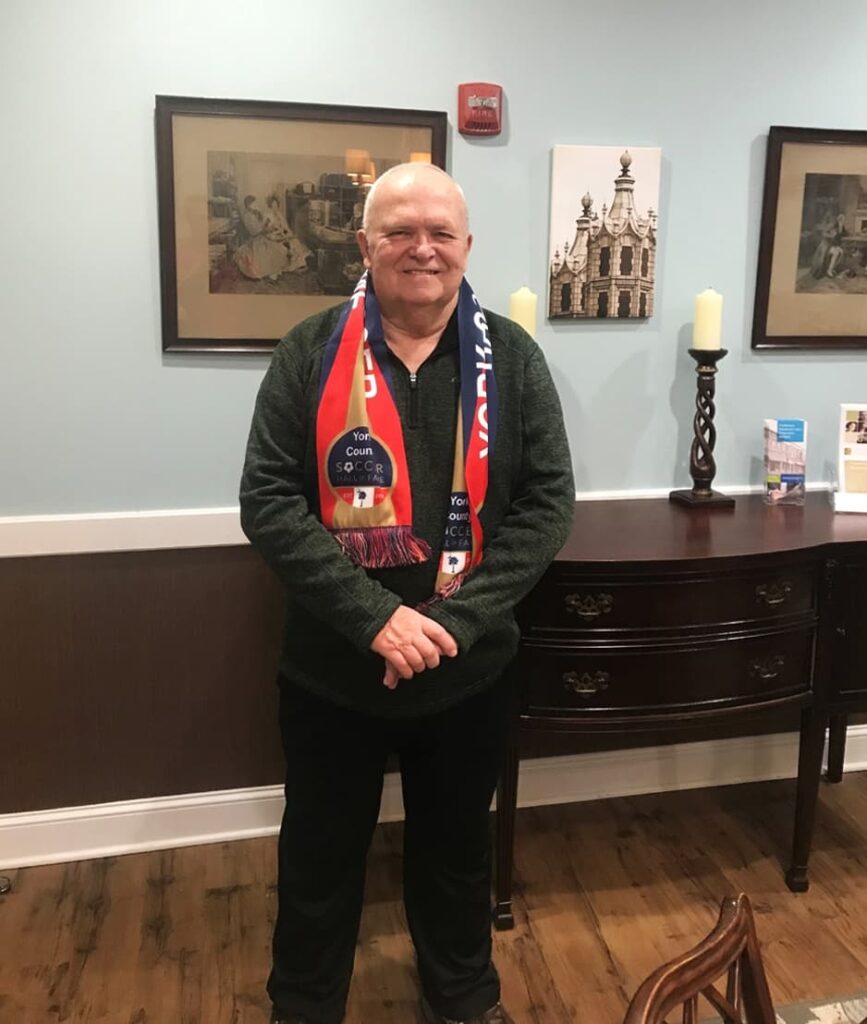
Jim wearing the soccer scarf that was part of his induction
into the York County Soccer Hall of Fame.
I had a fairly extensive background in the sport. I played in college; started the soccer program at Hargrave Military Academy in Chatham, Virginia in 1964; was a member of NISOA (the National Intercollegiate Soccer Officials Association) for many years; played for the Nashville Internationals while I was in graduate school; and helped start a club soccer program for adults as well as a youth program when I first came to Rock Hill, SC (where I still live). I enjoyed appreciable success as a coach and oversaw Winthrop’s transition from an NAIA school to a Division 1 program, but in retrospect one aspect of the “soccer years” of my life stands out above all others. That was my interaction with and hopefully at least some shaping of the guys whom I coached. I remain in fairly frequent touch with a number of them and take inordinate pride in seeing what fine men so many of them became.
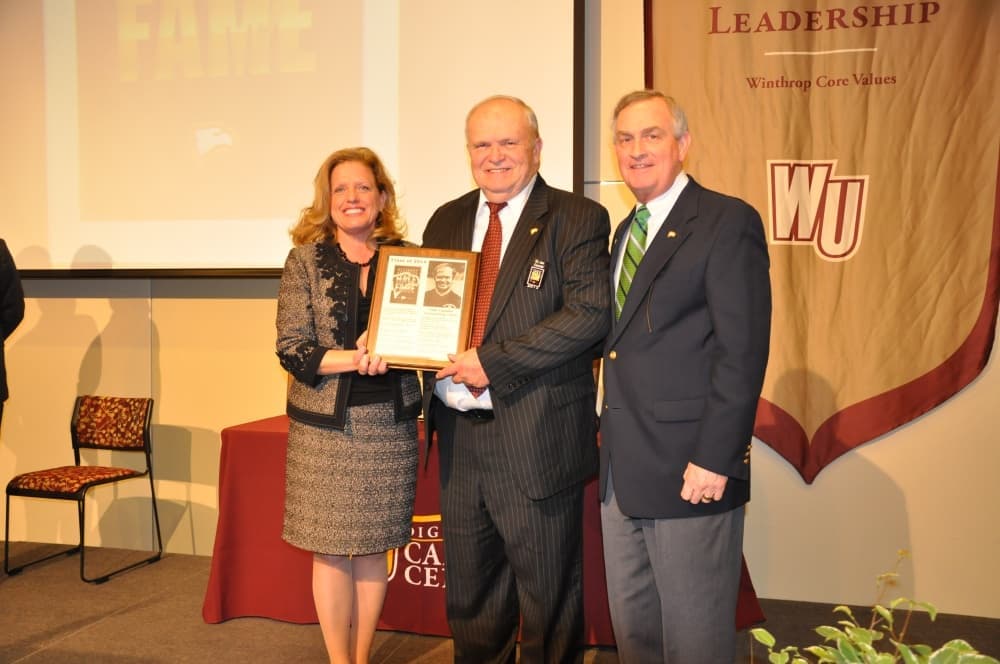
Jim, flanked by Winthrop’s president and athletic director, at the time of his induction into the university’s Athletic Hall of Fame.
Looking back, those coaching days were in effect just an extension of my chosen profession. I was teaching, but instead of trying the bring the past alive and make it worthy of studying in the classroom, I was offering lessons and guidance of a different sort. In part it involved soccer skills and teamwork, but I flatter myself to think I was better as what might be called a “life coach.” Whatever the case, there are hundreds of guys out there, now retired or closing in on it, with whom I had the joy of sharing endless hours on the pitch, on road trips, in gyms (we played a lot of indoor soccer during the winter months), and in team meetings. It brought glory to my life and, in retrospect, I guess it is a part of it that seems strangely remote from my endeavors as a writer.
JIM’S DOIN’S
I’ve been busy as all get out in recent weeks, mainly trying to juggle three books at once (pretty much everything except the final touches involving proofreading, photo selection, and contemplating marketing strategy with the publisher are done for two of them—Profiles in Mountain Character: A Smokies Sampler and the collection of John Parris’s food writings and recipes). It looks like both will come out early in 2027. The third work, being co-authored with my brother, Don, will feature vintage photographs of the place where we grew up (and where he now lives in retirement), Bryson City and Swain County, NC. My weekly columns continue to appear in the Smoky Mountain Times. Other recent publications include ”Cane Pole Days: A Vanishing Southern Scene,” Columbia Metro, June, 2026, pp. 36-41; “The Heavenly Strawberry,” Smoky Mountain Living, June/July, 2026, pp. 7-9; ”The Grandfather Factor,” Sporting Classics, Spring, 2026, pp. 44-48; Zane Grey: American Sportsman,” “Sporting Classics Daily,” June 9, 2026; “Those Were the Days: Where Is the Boy with the Slingshot?,” “Blind Pig and the Acorn,” June 25, 2026; ”Frank Young: An Angler for the Ages,” “Sporting Classics Daily,” July 2, 2026; and “The Grandfather Factor,” “Sporting Classics Daily,” July 7, 2026.
************************************************************************************
RECIPES
THE CULNARY BEAUTY OF BUTTERMILK
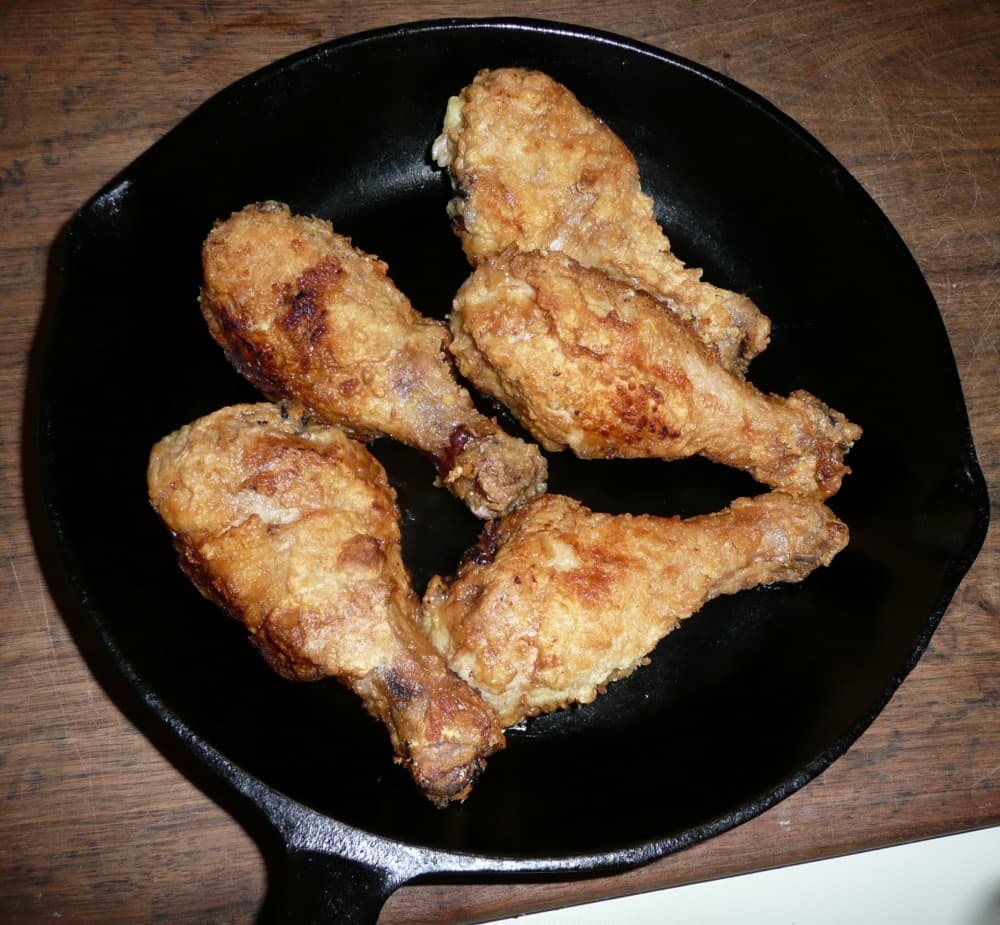
Buttermilk makes an excellent marinade for chicken and
will result in mighty tender fried pieces of preacher bird.
I’ve always enjoyed buttermilk even as I recognize it isn’t, at least in the normal liquid form, for every palate. But give me a nicely chilled glass of buttermilk straight from the refrigerator after a spell of work outside on a hot day, and I’ll grin like a mule munching sawbriars. During my boyhood many of the adults I knew considered a cold glass of buttermilk on a hot summer’s day a treat ranking right alongside seasonal delights such home-churned ice cream or watermelon. Yet coming in from hours of garden work to be handed buttermilk fresh from the spring or refrigerator or taking a hard-working woman taking a richly deserved break on laundry day for the same type of enjoyment was but one example of the surprisingly varied uses found for this staple of old-time mountain culinary ways.
Of course buttermilk really shines when it comes to baking, and buttermilk biscuits and buttermilk pancakes are especially well known. Yet there are myriad other uses, and the recipes and suggestions below touch on a few of them along with offering a couple of temptations for the sweet tooth. I would note that today’s cultured buttermilk is a bit of a pantywaist pretender in comparison to the traditional by-product of butter making, but it retains some measure of the tangy delight the “real McCoy” once brought to mountain palates.
Buttermilk, far from being a mere beverage or a component in certain types of baking, is in reality a sort of cross between liquid refreshment, a condiment, and a key ingredient in recipes that can bring culinary delights on many fronts. The recipes offer a sampling, and anyone who likes to experiment a bit in the kitchen will find buttermilk a staunch companion with potential uses in baking, marinades, dressings, and more. Try the recipes, but you might actually find the hints for usage even more appealing.
BUTTERMILK SALAD DRESSING
If you enjoy creamy salad dressings with a bit of bite, consider making your own. One of the delights of doing this is that you can customize to suit your tastes and another is that the options pretty much amount to the boundaries of your imagination. Here’s one suggested approach, and it’s great not only atop green salads but as a topping for cornbread salad, dipping sauce for wild turkey tenders, mustard-fried venison bites, French fries, cornbread sticks, pizza slices, and more.
1 or 2 minced garlic cloves
Salt to taste
¼ cup chopped fresh parsley (or use dried flakes if you don’t have it fresh)
1 cup real mayonnaise (don’t skimp here with diet stuff)
½ cup sour cream
Buttermilk mixed in until you have the desired consistency (I like it creamy to the point of being slightly runny)
Cayenne pepper, paprika, oregano flakes, or Tabasco sauce according to personal preferences—all are optional)
Mash the garlic and salt into a paste and add parsley or other herbs. In a bowl combine with the remaining ingredients and taste, adjusting seasonings if you wish. Chill before serving. This will make about 8 hefty servings of dressing and keeps well in the fridge in a closed container for 10-14 days.
You can buy various types of buttermilk dressings from store shelves, but I think you’ll find this one a dandy, and it has the virtue of being adjustable according to your taste.
BUTTERMILK IN BAKING
Fast food restaurants tout “buttermilk biscuits” as one of their top draws, and if you are fortunate enough to get one fairly fresh from the oven, they can be a treat. On the other hand, if you have the misfortune of ordering towards the end of a run, they may be better suited for rock skipping or use as a substitute for clay pigeons on a skeet course than human consumption. But if you use buttermilk in your baking and home, things are in your control. Here are a few thoughts along that line.
*If you have some type of flour mix that promotes itself as buttermilk based, it is still going to call for the addition of water or milk. Instead of that, if you want a real difference, use buttermilk for the mixing process. For example, my family thinks I’m a mighty fine hand at pancake making. I don’t really have a secret, but I start with Pearl Milling buttermilk pancake mix and add buttermilk, an egg, and a couple of spoons of corn oil to make my mix. At the proper consistency the end result from the griddle is a gift from the culinary gods.
Incidentally, at this point I can’t resist the temptation to say that Pearl Mill pancake mix used to be the Aunt Jemima brand before a bad case of political correctness laid hold on some fool in upper level management. In my eyes, far from being racist, Aunt Jemima was an honor, recognition of superior cooking skills seldom if ever matched. There was a black “Aunt” in my boyhood, Aunt Mag Williams. She lived just down the road, was as joyful and hardworking a soul as you’ll ever meet, and earned the titular “Aunt” because she was universally respected. She will form the subject matter of the second chapter in my forthcoming book, Profiles in Mountain Character: A Smokies Sampler. Incidentally, it presently looks like the work will (finally) be out in early 2027.
*Consider using buttermilk, either by itself or in a dressing similar to the recipe above, as a dipping sauce. Everything from wings to celery and carrot sticks, cucumber slices and radishes, benefit from the tasty tang it brings.
*Coat cubed venison steak (or beef steak if you can afford it) with a brushing of buttermilk before dipping it in flour and then pan frying. I love mustard-fried venison steak but if anything, buttermilk is better. Cut the steaks into small pieces after they are fried and serve as an appetizer. You’ll be pleased.
*Experiment using buttermilk as a marinade with chicken, pork, or beef (for me, venison). The lactic acid in the buttermilk does an excellent job on the tenderizing front, and with meats that can be dry, such as chicken breasts or some cuts of pork, it helps with moisturizing as well.
BUTTERMILK RAMP BISCUITS
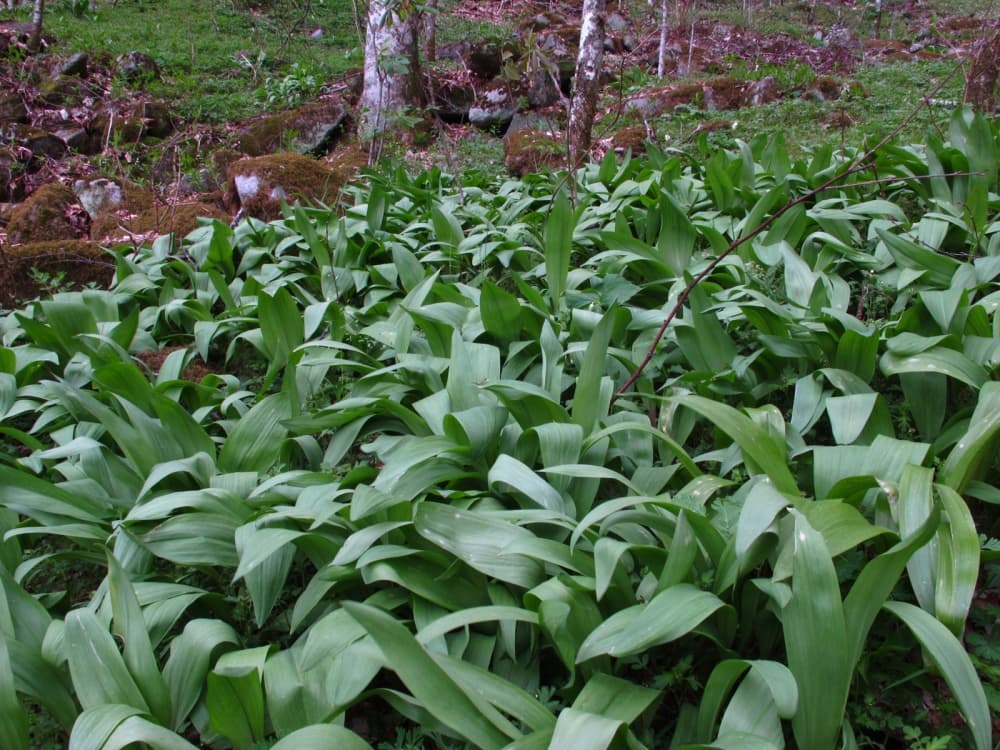
A big patch of ramps just begs for some of them to be used in biscuits
(photo courtesy Don Casada).
If you hail from pretty much any part of rural Appalachia, you’ll be familiar with the tasty but decidedly pungent wild vegetable known as ramps. Consumed in the raw form, while mild to the taste, ramps will make a skunk slink away in shame at the inferiority of his smell or, to put it another way, anyone who has eaten raw ramps redefines halitosis. Fortunately once cooked the tasty treat from spring wildwoods loses its aftereffects but not its taste appeal. Ramps have become increasingly prominent in high-class restaurants, but this recipe will take you several steps beyond anything they can offer.
1 tablespoon active dry yeast
½ teaspoon granulated sugar
¾ cup buttermilk at room temperature
1 ¾ cups all-purpose flour, divided
½ cup semolina flour
2 teaspoons baking powder
1 teaspoon salt
½ teaspoon baking soda
Big bunch of ramps (maybe a third of a pound)
10 tablespoons unsalted butter (8 cold and cubed and 2 melted)
8 tablespoons corn oil or vegetable shortening (you can use the equivalent of real lard if you wish)
Mix yeast, sugar and 4 tablespoons of the all-purpose flour. Add buttermilk and whisk thoroughly. Cover with a dish towel and let sit for 30 minutes—at that point you should see a bit of foaming on the surface
Wash and dry the ramps then rough chop both the light green and white parts and mince in about 2 tablespoons of the dark green upper leaves.
In a mixing bowl combine the remaining flours, baking powder, baking soda, and chopped ramps. Add butter and shortening and use and electric mixer on medium high until pebbly.
From a well in the middle of the resultant mixture and pour in the yeast. Mix gently by hand until just combined.
Using floured hands, turn out the dough, which will seem sticky and wet, onto a floured surface and knead gently. Once the dough has a bit of “bounce back” to it form into a ball and then mash it (by hand) into a disc about ¾-inch thick. Cut out circles with a biscuit cutter.
Brush with melted butter and let rest, uncovered, for an hour.
Preheat oven to 400 degrees and place biscuits on a treated baking sheet (or one lined with parchment) and bake until brown (18-20 minutes).
This is a time-consuming process but rest assured the end result is pure delight.
BUTTERMILK PIE
If the buttermilk ramp biscuits recipe is complex, here’s one that is the essence of simplicity, with the actual prep time being less than a quarter of an hour. It’s also flat-out delicious. I remember it being brought to gatherings such as family reunions or Decoration Day when I was a boy, and you could flat-out guarantee there wouldn’t be any leftovers.
1 ½ cups sugar
½ cup unsalted butter
1 cup buttermilk
3 large eggs
3 teaspoons all-purpose flour
1 teaspoon vanilla extract
¼ teaspoon ground nutmeg (optional)
1 (9-inch) pie crust
Preheat oven to 350 degrees. Beat sugar and butter together in a large mixing bowl until smooth. Then mix in eggs, flour, and vanilla. Pour the filling into the pie shell and sprinkle with nutmeg if you like the flavor. Bake until the crust is golden brown (50 minutes to an hour). Allow to cool on a pie rack before attempting to serve. Any leftovers should be refrigerated.
CORNBREAD SALAD AND BUTTERMILK
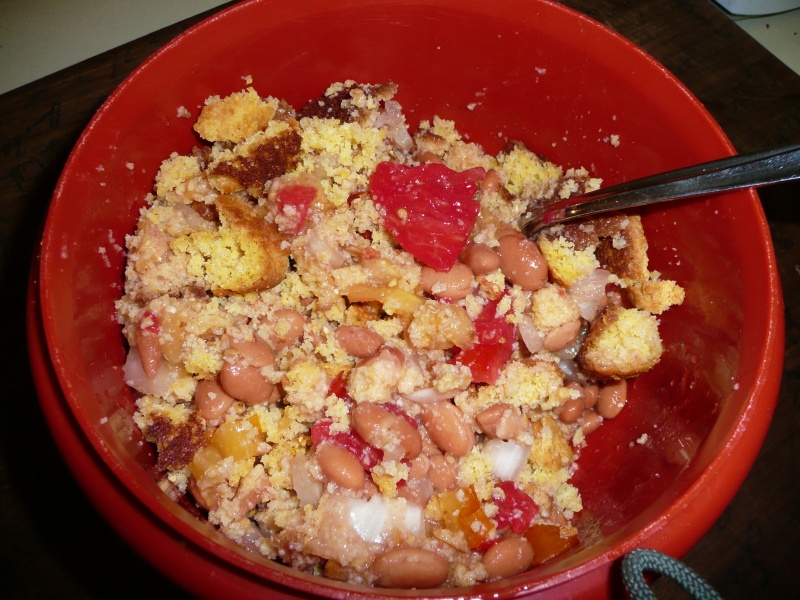
A bowl of cornbread salad awaiting adornment by a good splashing of buttermilk.
I’ve covered cornbread salad in previous newsletters, but just as a reminder it is crumbled cornbread mixed with whatever vegetables, raw or cooked, you might have available. Good choices include tomatoes, bell peppers, cucumbers, summer squash (raw), corn (cooked or raw), crowder peas, and green peas. Buttermilk makes a great dressing for cornbread salad. Just mix the cornbread and veggies, douse with buttermilk, adorn with a good sprinkling of black pepper, and dig in.