JANUARY REFLECTIONS
Toward the end of this month my earthly years will number four score and four. One cardinal characteristic of reaching such a point is that your mind (or at least mine) becomes increasingly inclined to look to the past. I have no doubt whatsoever that I am being bathed by what Boxcar Willie described, in a wonderful song I would strongly encourage you to listen to, as “The Winds of Yesterday.” For me, most of those breezes are balmy ones, soothing, sweet, and wonderfully satisfying. But links to my earlier years also bring sadness, although far more often than not it is tinctured by realization that mixed in with longing and a sense of loss is a great deal of gladness. Here are some particularly impactful examples, and I strongly suspect that if you reflect on your own years you’ll find parallel experiences aplenty.
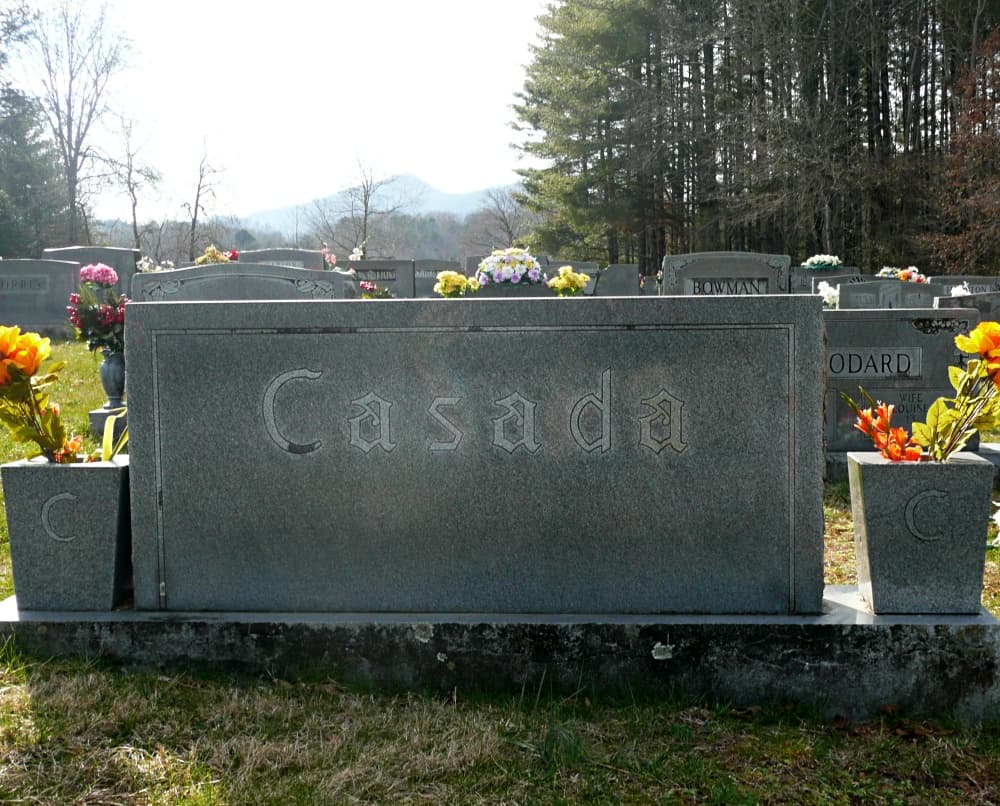
The background to the gravesite of my parents captures much of the beauty of the Smokies. Grandpa Joe and Grandma Minnie take their eternal rest nearby, as do uncles and aunts.
*Mixed feelings about the first month of the year. Both of my parents died in January; Mom in 2000 at the age of 86 and Dad in 2010 at the age of 101. While each of them lived long, full, sometimes hard, but mostly happy lives, the month always brings me a certain degree of depression–that’s despite the fact that it’s also the month of my birth. While I think of my parents often and, with each passing year, have an increasingly realization of how blessed I was, I never quite manage to escape a certain degree of mental mollygrubs in this month
*My inability, at the age of 25, to attend the funeral of my beloved Grandpa Joe Casada and serve as one of the pallbearers at the service. He died on Thursday, February 23, 1967. The timing gave credence to his oft-uttered thoughts that “February is the meanest month” and “the reason February is the shortest month of the year is that a body couldn’t stand any more of it.” His passing was not unexpected, although a call from my father to the prep school in Virginia where I was a teacher and coach to share the sad news deeply troubled me. That was at least in part because I was scheduled to take the Graduate Record Exam (GRE) on February 25, the day on which his funeral service and burial were scheduled. It would be my last opportunity to take the GRE if I was to follow my plans to marry that summer, hopefully gain admission to graduate school, and begin my studies either in the summer or, at latest, in the fall semester.
Daddy and I talked it over a bit and both of us realized the only logical thing to do was miss the funeral and take the GRE. The whole experience was emotionally wrenching and certainly I didn’t go into the exam room on the University of Virginia campus with an optimal outlook. However, my soon-to-be wife went with me, offering a much-needed mental boost, and another consideration helped ease my angst. That was realization that I had, in effect, already said my goodbyes to Grandpa. Moreover, there was no doubt whatsoever in my mind that the old fellow whom I loved so dearly would have insisted, with his infinite store of practical, homespun wisdom, that the only thing to do was take the GRE.
*My future bride helped shepherded me through that moment and many more, and any time I look back on our half-century plus together a mental light shines on some long forgotten example of how she helped shape my career in ways that varied from proofreading to typing (my master’s thesis and doctoral dissertation, not to mention my first several books and literally thousands of magazine and newspaper pieces, were prepared on a typewriter), from content suggestions to being co-author of several cookbooks. As Ann faded ever deeper into the abyss that is dementia, clinging to some slight vestige of life for almost a decade, there were daily opportunities as I visited her, never mind that she didn’t know who I was or even that I was present, to reflect, remember, and mentally reminisce.
There is now another woman in my life, what I guess you might call a lady friend, and we see each other fairly often and talk several times a week. She’s faced tougher obstacles over the years than has been my lot yet somehow manages, almost always, to keep on the sunny side of life. Our relationship is good for both of us, or at least I flatter myself to think that’s the case, and her boundless optimism, deep-rooted goodness (she was a nurse anesthetist for an incredible 55 years), and shared mountain roots (we’ve know each other since beginning first grade together) certainly help. That doesn’t mean, however, that I can’t or shouldn’t remember the countless moments of magic a marriage produced. Also, as was the case with Grandpa, thoughts of Ann are far more likely to elicit a smile than a plunge into despair.
*A boyhood accident that occurred in January and has plagued me ever since. It was a bitterly cold spell in January and a bunch of us teenagers were out “skating” (that meant sliding across a frozen pond in shoes or boots, because certainly none of us even approached the financial wherewithal to own a pair of skates) on Sunday afternoon. A buddy pushed me from behind without my having been aware he was there, and I fell face-down on the ice with my nose and upper front teeth taking the full impact. The blow caved in all the teeth between my upper canines. While a dentist who was way ahead of his time managed to ease them back into place, that marked the beginning of decades of root canals, eventual extractions, abscesses, dentures, and misery (as well as expense).
*General memories of my parents, never mind what I noted about them above in connection to this month of the year. If you read last month’s newsletter, which shared Christmas-related stories of Momma and Daddy, you are aware of how blessed I was in my boyhood. Our family may not have had a lot in the way of material things, but there was always food on the table, the stability of a two-parent family, a deeply-rooted devotion to the worth of work and a work ethic, the pillar of faith, and the blessings of growing up in a small town. My parents gave guidance, discipline, love, and embraced a zest for life. To me those are considerations far more meaningful than the wealth they never had. My inheritance was one that far transcended mere monetary considerations.
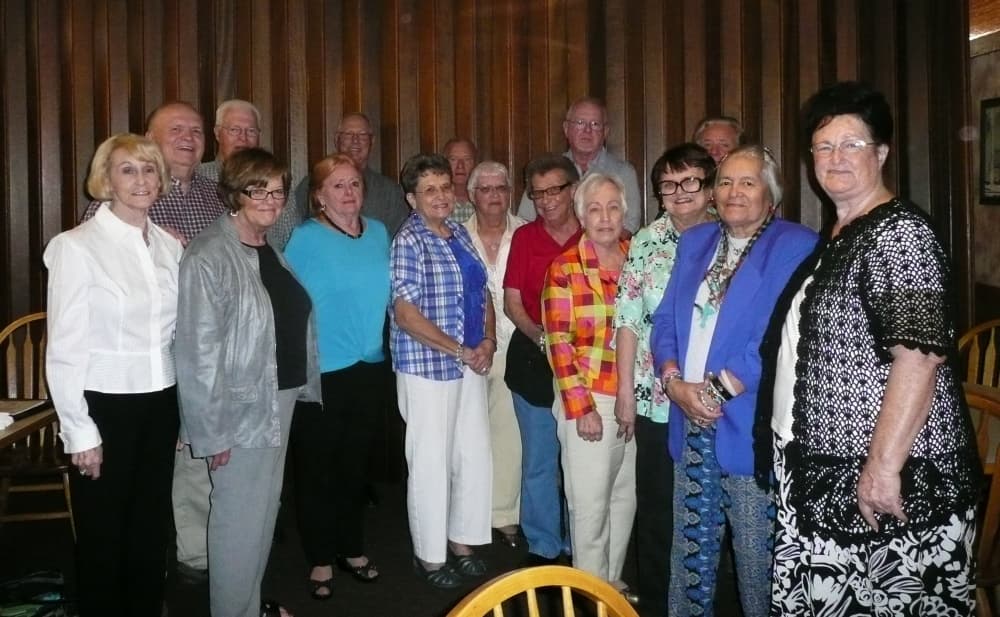
A 2014 reunion of my 1960 high school class. Since that image six
of those shown in the photo, along with several others, have passed.
*I’ll conclude with one other upbeat thought connected to January. As a boy the month provided me countless moments of sheer joy. Among them were high school basketball, sleigh rides on the abundant hills around my boyhood home, early moments of teenage romance on those sledding outings as a bunch of boys and girls paired off for fun in the snow, enjoying snow cream whenever there was a decent snowfall, rabbit hunting in the heart of the season every Saturday as well as any time there was enough snow for school to close (and that was fairly often thanks to treacherous mountain roads and the fact that most bus drivers were teenagers), and the carefree joys of wandering around in a barren yet beautiful mountain landscape.
JIM’S DOIN’S
I’ve spend much of my work time in recent weeks involved in efforts of a long-range nature rather than ones that show any immediate “return” in the form of printed words. For example, I attended a delightful surprise party connected with the retirement of an editor, Joey Frazier of South Carolina Wildlife magazine, with whom I’ve worked for many years. Joey was always a dream editor for a writer—gracious, understanding, highly competent, and one of those rarities (at least from this writer’s perspective) who consistently made me look better. I’ll miss his gentle guiding hand, but by the same token am delighted that his successor, Cindy Thompson, has been with the publication for many years and has all the skills necessary to follow in Joey’s footsteps. Another change comes at Sporting Classics magazine, a publication I’ve been affiliated with for four decades, and again it involves a new editor, Skip Knowles. I don’t know Skip personally, but he’s been an editor and writer in the outdoor world for many years. I look forward to meeting and working with him as he takes over the reins of a magazine that has been the nearest thing to a “constant” in my many years as an outdoor communicator.
As for work, I continue plugging along on the cookbook connected with the grand old North Carolina mountains writer from yesteryear, John Parris, along with a second one focusing on my beloved highland homeland of Bryson City, NC. Then there’s the constancy of my weekly column in the little newspaper serving that town, the Smoky Mountain Times. Other recent efforts include “What’s a Meal Without Gravy?” in the Dec./Jan. issue of Smoky Mountain Living (several of the recipes from that column are included in the offerings below), pp. 6-9; ”Merry Memories,” Columbia Metro, Dec., 2025, pp. 106-12; and “Indoor Winter Recreation in Days Gone By,” Carolina Mountain Life, Winter, 2025/26, pp. 69-70.
RECIPES
SNOW CREAM
In recent years snow on the local scene has been about as scarce as hen’s teeth, but the forecast for a few days down the road suggests there’s a possibility of that happening. I enjoy a blanket of white spread like a pristine table cloth across nature’s sprawling landscape, and when I was a youngster a good snow always meant a day or more out of school and, if several inches fell, Momma suggesting, just like the kid at heart that she was, “Let’s make some snow cream.” It was the essence of simplicity. She’d send us out with a big dishpan and directions to fill it up while making sure to scoop up only the upper two or three inches of the snowfall. Once we had it back in the house, she would hastily mix in some sugar, vanilla extract, whole milk or whipping cream, and maybe some fruit from the freezer such as peaches or berries, stir it gently with a big wooden spoon, and we’d all dig in. Truth be told it probably wasn’t the tastiest of sweet treats, but it involved a touch of adventure, a key ingredient that was free, and just a hint of culinary romance. The memory of the fun connected with snow cream is a fond one.
HAMBURGER GRAVY
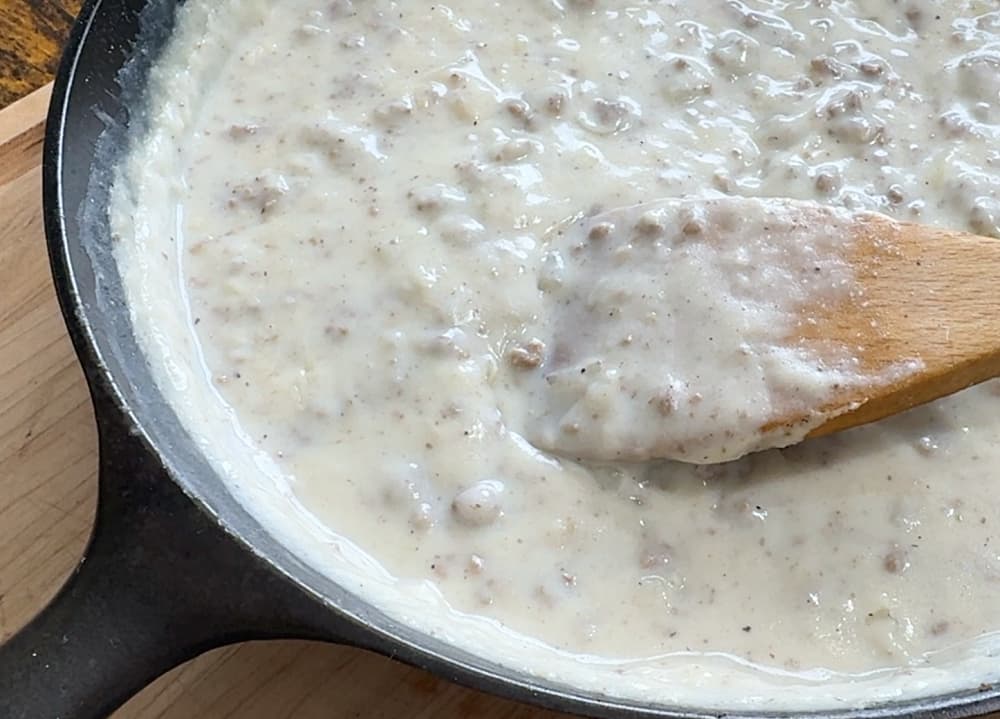
Many Appalachian families a few generations back, and it was certainly true of mind, were more likely to enjoy the flavor of beef in gravy than any other way. A half pound or so of the least expensive ground beef available (i. e., that with the highest fat content) could be stretched a long way when made into gravy and served atop biscuits or crumbled cornbread. You got the savory taste of meat without much expense.
Half pound of ground beef with 25-30 percent fat content
½ cup (or more) of all-purpose flour
1 cup of milk
Salt and pepper to taste
Fry the meat then drain the grease and set the hamburger aside. Using the hot grease as your base, make a roux by gradually adding and browning flour. Then pour in milk a bit at a time, stirring constantly as the gravy thickens. When you approach the desired thickness for the gravy, sprinkle in salt and pepper along with adding the reserved burger. Heat everything again using milk as a thinning agent as necessary. You can control the thickness of the gravy by how much flour and milk you use, and if the gravy is relatively thin a little burger goes a long way—and still keeps the taste of beef even though the mixture is mostly milk and flour.
CUBED STEAK AND GRAVY
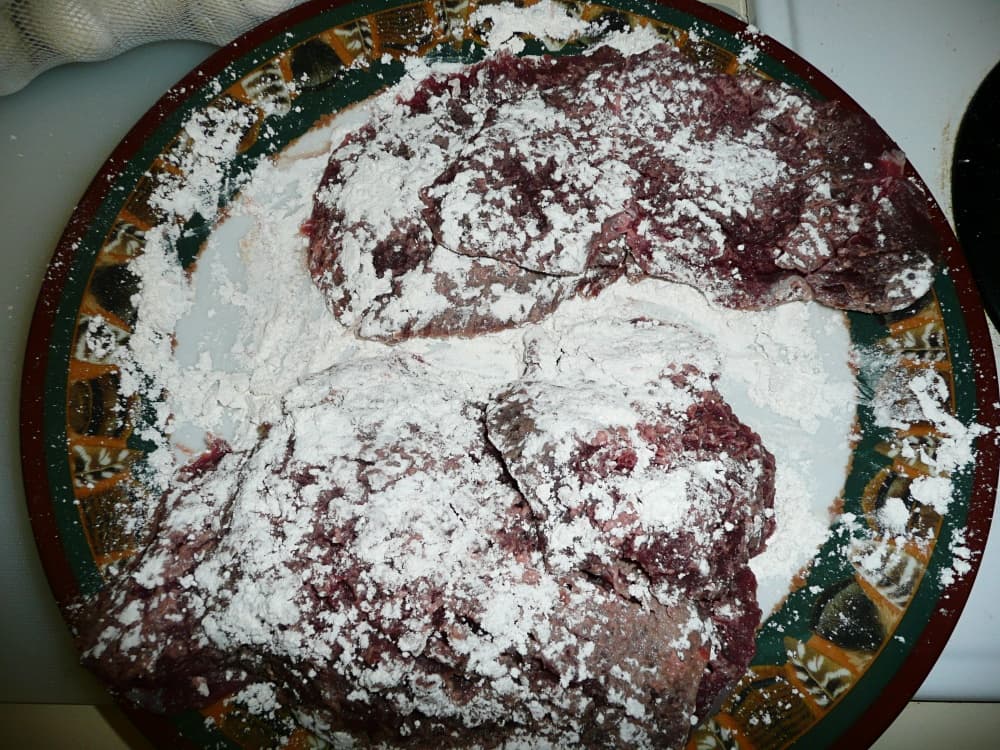
Cubed steak and gravy makes mighty fine eating, and plenty of flour,
on the steak means lots of crusty little tidbits to go in your gravy.
1/4 to 1/3 pound of cubed steak per person
Cooking oil or bacon grease
Flour
Milk
Salt and black pepper
Thoroughly coat individual pieces of cubed steak (store-bought beef or venison from your own hunting) with flour seasoned with salt and pepper. It isn’t a bad idea, especially if you want “cut with a fork” tender steak, to give it some extra pounding on a cutting board before flouring. I got a handy-dandy tenderizing device for Christmas that has a face that is in effect several dozen tiny knife blades or ice pick points. You push it down on meat and the first thing you know the toughest cut from an old buck is cut-with-a-fork tender. Fry the pieces in a large sauce pan or skillet holding a bit more oil than you would normally use for frying meat. Remove the meat with tongs and place on a plate, covering with a “tent” of tinfoil for warmth. Be sure to leave any of the brown goodness that falls off during the frying process in the pan.
Once the meat is removed immediately add enough flour to the hot pan, stirring with a whisk as you do so, to make a roux. As an aside, don’t let the fancy, Frenchified word roux be “off putting,” to use mountain vernacular—it’s just a mixture of flour and grease that serves as a thickening agent in the gravy-making process. If you get a bit too much flour, and making a roux is pretty much a “judge by looks process,” add a bit more oil (or butter). Once the roux is the right consistency, with all the flour thoroughly blended in and nicely browned, add milk, whisking constantly as you do so. If the gravy in the making seems too thin add a bit more flour; if too thick, add more milk. You can also increase the amount of gravy this way, and in my view you never have too much. When it reaches a desirable consistency place in a gravy boat for serving or, alternatively, put the steak in a large container and pour the gravy over it for serving.
GIBLET GRAVY
While there’s nothing wrong with enjoying dressing or a slice of turkey in an unadorned state, they really cry out for a lavish ladle of giblet gravy spooned over them. I’ll leave the gravy-making details to your individual tastes (a thin gravy made without milk or milk gravy are the two most common choices), but I do have a suggestion that will make it meatier and better. The next time you kill a wild turkey, save not only the giblets (heart, liver, and gizzard) but all of the dark meat (legs, thighs, wings, and medallions on the back) and freeze it until ready to use. If you wish you can also add tidbits such as the hearts of doves. Place the dark meat in a large stock pot and keep it simmering for at least a couple of hours. The meat will never get really tender, but it will reach a point where you can remove it from the bones. Do so, and keep the stock as well. Chopped into small pieces and frozen with the giblets (add them in the final half hour of simmering), you have the makings of giblet gravy richly laced with nutritious bits of turkey. Combine it with some of the stock you saved and the juices from your baked domestic turkey, and you can produce an abundance of gravy and have the good feeling associated with fully utilizing your wild bird. Alternatively, you can buy extra domestic turkey or chicken organ meats, perhaps along with a package of chicken wings, and do the same thing. Of course the latter won’t require lengthy cooking.
TOMATO GRAVY
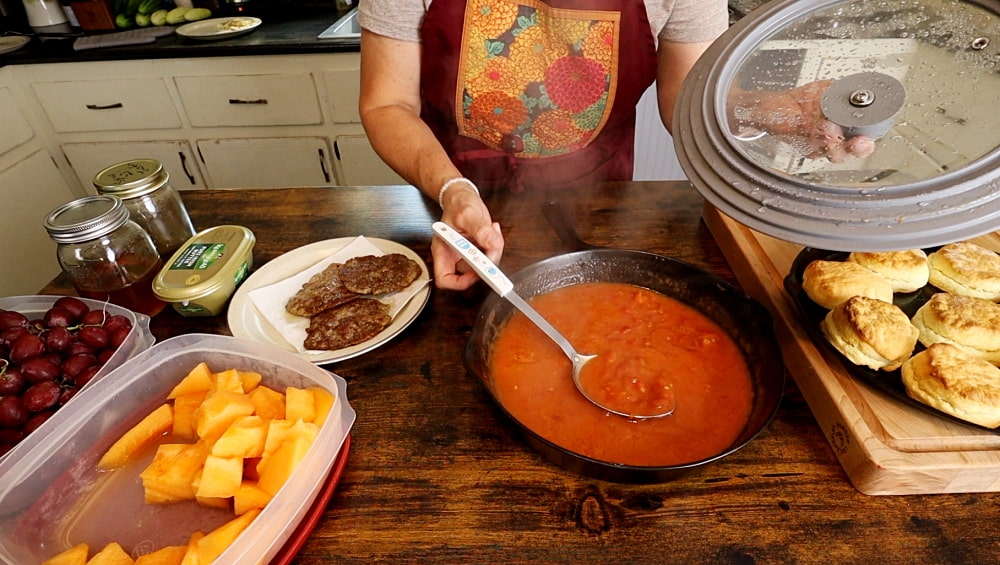
2 cups chopped tomatoes
2 tablespoons bacon drippings
2 tablespoons all-purpose flour
Water
Dash of sugar
Salt and pepper to taste
Add flour to hot bacon drippings and cook for 2-3 minutes while stirring steadily. Season to taste with salt and pepper as the mixture cooks (you are in effect making a roux). Stir in tomatoes and add a dash of sugar. Cover over low heat until mixture thickens. Depending on how juicy the tomatoes are, water may need to be added to thin the gravy to the desired consistency. This recipe is a favorite summer breakfast item in many parts of the Appalachians but is tasty at any season.
TIP: Canned tomatoes may also be used. A variation is to sauté diced onion in the bacon drippings before adding the tomatoes.
CHOCOLATE GRAVY
We don’t normally think of gravy as a sweet treat, but it can be. This favorite Appalachian offering is a perfect example.
3 tablespoons flour
4 tablespoons sugar
2 cups water
3 tablespoons cocoa
Place flour in cast iron pan on medium heat; add sugar and cocoa and mix well. Gradually add water to mixture stirring constantly like you would for any other type of gravy. Serve over hot biscuits.
SAUSAGE/BACON/FATBACK GRAVY
After frying meat add flour to drippings and allow to cook for 2 to 3 minutes while stirring constantly. Salt, pepper and other seasoning can be added at this point. As you stir try to raise any little bits of meat that have cooked onto the pan. Doing so will ensure a very flavorful gravy. Slowing add milk to pan stirring constantly. About 1½ cups of milk are usually needed, but of course that needs to be adjusted to the amount of grease you have and how many folks are to be fed. Adjust the thickness as desired just before removing from the heat. Serve over warm biscuits, crumbled cornbread, slices of loaf bread, or even big slices of tomato.
CORNMEAL GRAVY
About 3 or 4 tablespoons of bacon, fat-back, or hog jowl grease
½ cup of cornmeal
Milk
Salt and pepper to taste
Brown cornmeal in hot fat; add other ingredients and stir till thickened. You probably noticed this is not an exact recipe. I’ve found making gravy to be one of those things you have to do over and over till you figure out the method that works best for you. I add cornmeal or flour by the spoonful until I get enough in the pan to mostly soak up all the grease as it browns. Then I add milk to my thickness preference. I like my gravy thin so I use more milk than most folks. As gravy cooks you can add additional milk or water to thin it out if it gets too thick on you.
SAWMILL GRAVY
True traditional sawmill gravy was heavy on cornmeal and light on flour. That was primarily because the latter was more expensive and less frequently ground in an era where most meal came from overshot mills turning grindstones or even tub mills. The gravy was often, though not always, made with sausage containing a lot of fat. You can get a modern version that still offers the crunch of cornmeal (keep in mind the old adage “white corn is for folks; yellow corn for critters”) combined with the smoothness of a flour base. Just mix a few tablespoons of unsifted cornmeal with your flour as part of the preparation process.